
Transcript for (S8E3) A Public Library with Lessons for Powering What's Next
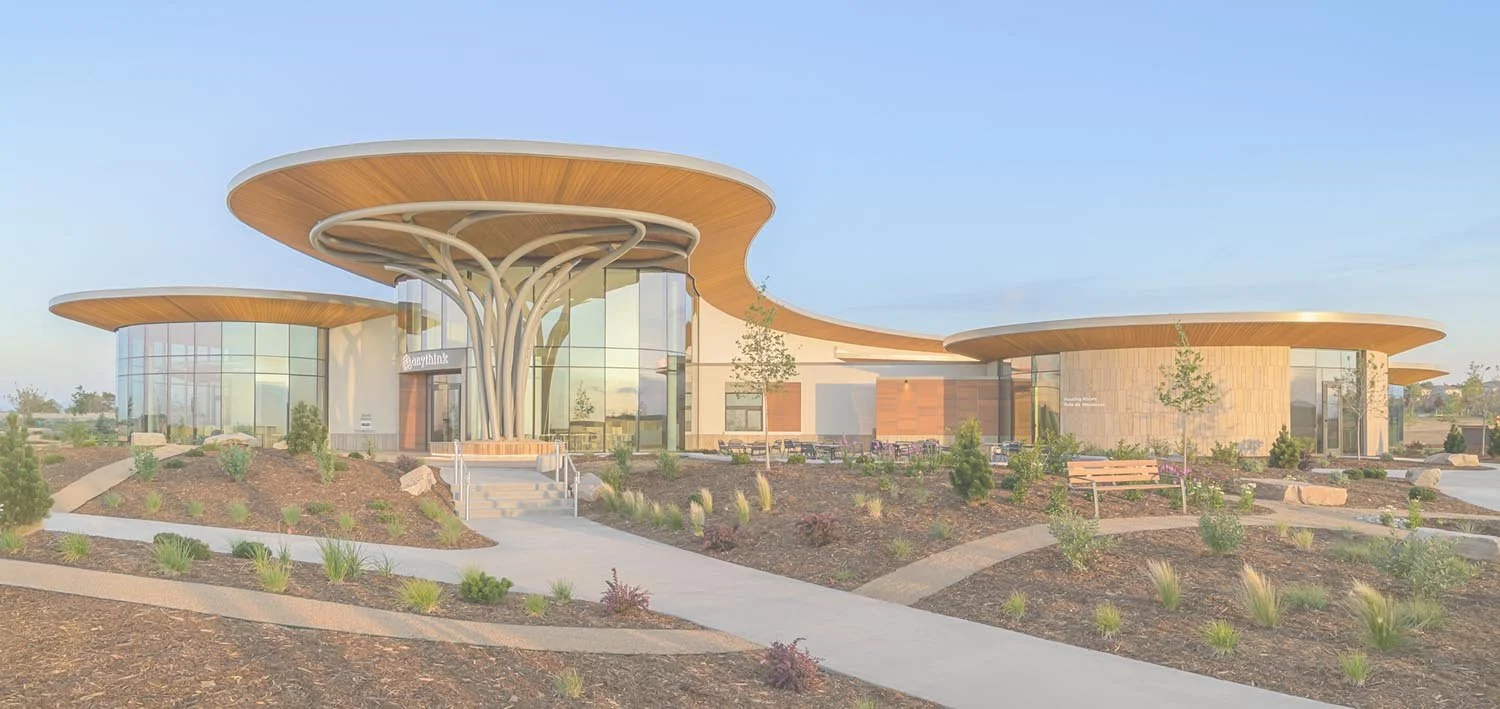
MARK: We heard from the residents that live around the property that they didn't want this big monolith that they could see from the street.
SID: Them blades of grass, really hide the building, and you're like, "I don't see the library," until you actually pull up the road then you're like, "Oh my God, Where did that come from?"
MARK: And so there's a sense of drama that brings you to the front of the building.
Narration: Mark Fink and Sid Whiting are part of a team that envisioned and executed a truly ambitious project– the first public nature library in the country. It opened this summer in the city of Thornton, Colorado just about 20 miles north of Denver. It was built by Anythink--
MARK: We're the public library system in Adams County, Colorado.
Narration: And Mark Fink is the Executive Director. With a population of half a million, Adams is one of Colorado's fastest growing counties and one of only two majority-minority counties in the state.
When Mark was brought on board in 2022, the concept for the Nature Library was in progress. The idea had sprouted from feedback that local residents wanted more access to the outdoors. And Mark felt it was critical for Native voices to be part of the planning process.
MARK: We formed an Indigenous Advisory Council for the Nature Library and this is where Sid got involved.
SID: [Sid introducing himself in Lakota[1] ] Hello, good morning, hello. Good morning, relatives. My name is Sid Whiting. I'm Sicangu Lakota from the Rosebud Sioux Reservation
Narration: At first, Sid says the Anythink team and the Indigenous Advisory Council were a little skeptical of each other. They also had an architecture firm that didn’t understand the vision of the project. But all of that would change…
I’m Brian Maughan, Chief Marketing and Innovation Officer at Fidelity National Financial, and this is Built, where you’ll meet creative leaders in commercial real estate. This season, we’re all about Powering What’s Next: reimagining the future of the built environment.
In this episode – a public project that can be a lesson for commercial real estate: how to partner with locals on innovative architecture and design.
SID: We weren't sure who these people were and they weren't sure who we were until we slowly started to create a friendship, and that was just being human towards each other and having that respect, for each other and the kinships that we built together, I think really pushed the project forward
Segment A
Narration: What exactly IS a public nature library? Well, for one, their collection is a little... different. Here's Mark Fink.
MARK: Our mission for this library is to help people find their place in nature, so that could be, they get excited about being able to check out snowshoes from the library and try snowshoeing for the first time.
Narration: At this library, with just your library card, you can borrow gear for hiking, camping, birding, skiing, tracking, and all kinds of outdoor activities. They've also got nature-related activities on site.
MARK: It could be attending a program with their kid on, learning different bird calls.
Narration: Even the design of the building reflects the natural world.
MARK: If you look at the nature library from an aerial view, it looks like three blades of grass blowing in the wind. 'Cause we sit on the prairie where it's very windy, and there are native grasses. So the location really inspired the shape of the building.
Narration: We visited the nature library ourselves to see the innovative design; and we talked with some patrons.
cues: Kid ambi to bed under
Narration: Dheanna Alexander comes every week with her three-year-old to check out books.
Dheanna Alexander: It has outside activities, lot of trails, paths for kids, sitting areas, and it's not just one kid section. It's multiple, and they can have the free range to explore.
Narration: Khalila Bachiri also brings her children.
Khalila Bachiri: Their favorite part is the open space outside. They love that part a lot. Everything is in here. You have coffee, you have, uh, nature, you have books, everything.
Narration: Jack Price was here for the first time with a friend, just taking it all in.
Jack Price: The big stripe of plants over there is really cool, and I love the lighting and the color of the wall there. I saw the concepts before the building was built and to be honest, I didn't think that they'd actually be able to make it look this way. But it looks just like the pictures, and it's beautiful.
MARK: When you walk through the front doors, you see this bright, beautiful, expansive space.
Narration: This is Mark Fink again.
MARK: We have these really whimsical skylights and, a space that just welcomes you in, that brings elements of nature, into the library.
Narration: The nature library's design and function are based on a system called the kinship model–
MARK: That model really focuses on four ways that people engage with nature, and that's, in nature, for nature, with nature, and about nature.
Narration: Anythink has incorporated each of those philosophies into the design and operations of the building.
MARK: So for example, the About Nature section is where we have books on astronomy. And biology and mammals and all of that nonfiction collection.
Narration: The library's many gardens are part of the “In Nature” element. also--
MARK: We have trail maps. We've got hammocks that people can borrow. We've got camping gear, gardening tools.
Narration: They have night-hiking kits you can check out with headlamps, reflective gear, and poles. They have animal scat identification cards to help kids with tracking. They have flower care cards to help people plan and tend a garden.
MARK: We also have a zone for nature, which is this element of reciprocity so we have books on solar panels and composting and ways that people can become stewards of the land. And, we're providing them with gear and resources and programming to help them understand how they can give back to nature.
SID: It's really all-encompassing,
Narration: Here's Sid again.
SID: And the process begins with the stewardship of the land. Sometimes we think we're above the Earth because we use her as a resource, and we tend to, not, become accustomed to her being a partner and her being something that is actually a living, breathing entity.
Narration: To understand the significance of this place and how it came to be, we’ve got to travel back in time about a decade and a half - to when Anythink was still just the Adams County Public Library system.
MARK: At that time, we were the second worst funded library in the state of Colorado, and we were under threat of having branches closed due to lack of funding.
Narration: So some county residents got together and put a measure on the ballot to create a public library district. In Colorado, libraries can be independent districts - separate from municipalities.
MARK: That ballot measure passed, and we became the Range View Library District, and then at that point, we also went to the voters and asked for dedicated funding through property tax.
Narration: That critical measure also passed – meaning the library district had more money flowing in for daily operations.
MARK: And then to really set ourselves apart, We, rebranded as Anythink, and Anythink can really mean whatever you want it to, but really our mission is to open doors for curious minds.
Narration: Now they run 10 library locations including a traveling bookmobile, a library in the Metaverse called “Anythink World,” the nation’s first carbon-negative library, and two studio makerspaces.
Anythink already had three working library branches in Thornton back in 2019 when the city approached them with an idea to build something new – on a pretty unique property. It was 140 acres of open space called Aylor Open Lands.
MARK: You can see all the way to downtown Denver and see the skyline. You can see all the way to the airport, and you can see to the mountains. and, we knew that we could do something special.
Narration: Anythink had already been doing nature-related programming at most of their branches - with community gardens and outdoor summer activities for kids.
MARK: So we really leaned into that understanding that our residents wanted more access to nature,
Narration: When Mark joined Anythink, the nature library project was at an early crossroads.
MARK: Anythink was working with an architect and, I think that, the organization and the architect were having a hard time finding a common vision for what this project could look like and how what we would build really would provide more access to nature.
So we ended up firing the architect that we were working with, which was unfortunate, but then we hired Davis Partnership Architects. They're a local firm in Denver, and, we hired them because their team had similar values to Anythink and, they were very creative, very collaborative and working with us and helping us realize our vision,
Narration: It was around this same time that Mark brought on the indigenous advisory council. Sid Whiting is from the Lakota tribe and hails from South Dakota, but has lived in the Denver area for most of his life as a member of the wider Native American community there.
SID: It's in the Front Range, which is a spot that our original home tribes, the Northern Cheyenne, Northern Arapaho, the Cheyenne, Arapaho tribes of Oklahoma and the Ute tribes, called home.
Narration: When Sid joined the project, he was particularly impressed with the Anythink team’s ability to listen to native voices, to learn and change their tack when earlier plans weren't working.
SID: They just trashed it all and they said, "We're starting over from this point on with the, Native Advisory Council." And, that's the most impactful thing that I remember is them just putting everything else that they had up to that point aside and just adopting a whole another way of looking at things and a whole new way of doing things.
Narration: Mark and the Anythink team worked with the Indigenous Advisory Council in a very intentional way.
MARK: I wanted to understand the best way that we could move forward and try and neutralize that power dynamic so that we weren't bringing all of our own biases and perceptions to the project.
Narration: They brought in an outside facilitator to ensure all voices were equally heard and weighed. Anythink also paid the indigenous advisory council members for their time and participation. Then..
SID: We began to share meals together. And for my culture, that's a very important, s-staple of building relationship with someone. That's the first thing we do when we meet someone is usually offer them something to eat in our homes or wherever we might be. It's a nurturing effect. And, I believe it helped nurture us into a very consistent and gratifying relationship.
Narration: They did have a few moments of tension that led to compromise.
MARK: We were still needing to design a public library, so this was really a space meant for everyone. So understanding how we walk that line between, incorporating these elements into a really beautiful building, and have it be a public library and not be, like an Indian cultural center, for example. We struggled with that and, again, we had to make some compromises, with our decisions and our project, and there was some turbulence around that, but I think that our outcome was the best that we could have expected.
Narration: To illustrate how this relationship helped co-create the library that stands here today, I’ll let Sid tell you a story. It started one night at an ordinary meeting.
SID: It was, I think, a little bit after five o'clock in the evening, and, suddenly, all the lights went out. And we were like, "Oh, no." They were like, "Oh, it's the security. It automatically turns off the light." Well, as we were sitting there, we had mentioned that, our people used the darkness to teach the youth how to listen better and be more receptive to our creation stories and our storytelling, by the light of the tipi in the cold winter evenings.
As we mentioned that, the Anythink team thought that we were giving them advice, and they took it, and they ran with it, and they literally built a room like that for storytelling. It was incredible. It really was.
Narration: What began as a spontaneous anecdote in a meeting, exists in real life now as one of the main features of the nature library. Mark and Sid take us there.
SID: this is the dark room. Yeah. I call it the star lodge.
MARK: We're entering a dark corridor that is curved. We have a black wood finish. The finish is called shou sugi ban, and it's charred wood. It makes the exterior harder. It serves as the paneling that we have for the entire space. And, it also smells a little bit like a campfire.
We've just closed the door, so you can tell that this room is soundproofed.
We're entering a space that's a complete circle. We have a starry sky above us. We have a circular bench that goes around the room, and all the outside noise is gone. So immediately as you walk into the space, your shoulders relax, you can take a breath,
SID: it's kind of like a reflection site for allowing people to just, unwind and get away from sometimes what can be the chaos of the library, which is really wild to say, chaos in a library.
Narration: When Sid says “chaos” he could easily be referring to another area of the library that he and Mark take us to next.
MARK: So here we have, this really great, indoor boulder field, and we've designed it so it looks like a stream bed with boulders of all different sizes.
Narration: This feature was also inspired by indigenous beliefs.
SID: The wisdom of the earth is held by our grandfathers and our grandmother, and the grandmother is Unci Makha, and she is like the soil, the earthen part of where we live. And the other part is our grandfather, our Lala, and that is the stones that hold all the wisdom of the universe.
So we had suggested that we incorporate those two elements, and in doing so, they decided on putting the grandfathers in the building. Our term for them are E'ya for the rocks or the big stones.
MARK: And these boulders are very large and weigh thousands of pounds. So, the first thing that we did once we got the building enclosed was, to take these boulders from a quarry in Colorado. We had them delivered to the site, and then we had to place them in the library, and we had to decide exactly where they needed to go, because we had to build the library around the boulders.
Narration: And it turns out the boulders are magnets particularly for the younger patrons of the library.
MARK: We have kids that run into the library, they run to the boulder field, and it's like a conga line of kids on these boulders. They jump and skip and play on the boulders from one end of the library to the other, and then they run back and do it all over again.
Narration: The library keeps it interesting too.
MARK: We may have blue fabric that we put out one day and have kids go fish. Pretend like they're standing on a boulder and fishing. Or we can put red fabric down here and then it becomes lava, and we've got kids jumping from rock to rock to avoid the lava. So really this is just a space for kids to use their imagination, try some managed risky play, which they may not have access to in other places, and really just have a place to have joy inside the building.
SID: And then, of course, well, what were they gonna do with the Makah, the earth, the soil? They decided a mud pit that was connected right there worked perfectly well. So you could see how just some suggestions from us turned into realities for the library after the staff blended their knowledge and concepts into it.
Narration: So from risky play to messy play – patrons of all ages can follow the boulders downstream to the library’s very own mud pit. And both he and Mark are delighted by how kids and adults alike have taken to this attraction.
MARK: We didn't understand how excited everybody in Colorado was gonna be to go to the library to play in the mud.
Narration: The only hitch?
MARK: We had some drainage issues with the mud pit, and it turned into a mud pond. so we have to re-engineer the mud pit, to open next spring.
Narration: And while folks are waiting for a re-engineered mud pit, there's plenty of other ways to experience parts of the natural world here. There are 50 brass inserts representing animals, fish and insects native to Colorado embedded in the terrazzo floor in the front lobby.
SID: Right behind you, you could see an image of a tiny little buffalo there.
Narration: There’s a giant structurally-essential steel column designed to look like a cottonwood tree. There’s a curved living wall inside made entirely of plants. The skylights are designed to make the ceiling light look like shifting clouds.
MARK: Also something that you'll notice is all the windows in the building have little dots on them, it's bird-safe glass. And that was something that our community specifically asked for.
Narration: The library has an art and science lab for hands-on programming, 9 demonstration gardens plus a kinship garden and a learning garden. Not to mention, the entire building was constructed with environmental sustainability in mind.
MARK: We have 370 solar panels on the roof. We use geothermal heating and cooling. We're pursuing LEED Gold certification. This would be our fourth LEED Gold building that's part of our library system.
Narration: Out on the prairie that surrounds the building site, Anythink is also working to preserve and restore the native grass ecosystem.
MARK: The main work that we're doing is through, irrigation and several phases of reseeding,
Narration: Of course – turning these beautiful concepts of interconnectedness into a real building, did have a steep cost. When Mark and Sid came on board the project, the funding had already been secured.
MARK: We used certificates of participation to fund the project, and essentially, what that means is, we had investors that, provided the investment money up front, so essentially, it's almost like getting a mortgage, in a way that, it's similar to funding through bonds, but in this case, the building serves as collateral over a 30-year repayment of the investment.
Narration: But Mark and Sid did have to contend with one major obstacle.
MARK: We really had our first pricing exercise probably toward the end of 2023, and that was a time when construction prices were increasing quite rapidly, and also that was a time where there was a lot of inflation. So we had, $45 million that was dedicated to this project, and, after working with the advisory council and our architects and the contractor, the contractor came back with the first pricing for the project which was $80 million.
Narration: They knew they had to find a way to get the scale of the project back down to the size of their budget.
MARK: And so we did some value engineering. What that meant was, we lost some square footage in the building. So, our current building is 33,000 square feet. We also lost some height but we still have, 24 feet ceilings at the highest point of the building,
Narration: They had also planned to cover the roof with living plants.
MARK: But that was $3 million just in and of itself. So we ended up replacing the green roof with solar panels on the roof instead. We also compromised on some of the finishes.
SID: When we found out that the eighty million dollar projection was going to be the cost we were disappointed and we thought that a lot of our stuff was going to be cut entirely. But the Anythink team worked diligently to keep some of the Native concepts that we wished to be installed in the library alive.
Narration: It helped that Anythink had a good lease in place with the City of Thornton.
MARK: We were provided with 15 acres on this 140-acre site. We have a lease for a dollar a year for 50 years, and then we have two additional 50-year renewable terms.
Narration: They also had a development agreement with the city that shared the cost of building out the infrastructure surrounding the nature library.
MARK: So building out the intersection, building out the road that leads up to the library, how we were managing all 140 acres of the space. We had a really great working relationship with the city. I think that they were really excited that we were able to build something that's so iconic in the sense that it brings people from all over the metro area who are gonna spend money in Thornton when they visit the library. I would say that this is an example of what really great local government can do.
Narration: Of course integral to the project's success was partnering with Davis Partnership architects who were willing to go with the vision. And then finding a contractor, GH Phipps, who made sure those concepts became real.
MARK: The science and engineering and math that went into, actually executing the design, was amazing. And we really pushed the limits of the architects and the contractor for doing that work.
Narration: A perfect example of that dedication is the cottonwood tree column made of steel that helps support the ceiling at the front of the library.
MARK: It’s 18 tons of steel that was brought here in 50 different pieces. A local steel manufacturing company Zimmerman Metals actually fabricated the column, but each piece of steel had to be welded to exact specifications to fit the other pieces that it joined to.
They had to use VR technology for that, because it's structural, so it holds up the front roof line. And the technology for the welders didn't exist five years ago. So, we thought this feature column was beautiful and artistic, and also we didn't realize how challenging it would be for the team to actually construct it.
Narration: But construct it, they did. Mark thinks this commitment to going above and beyond had something to do with the uniqueness of the project.
MARK: We have a lot of construction going on in the Denver Metro area, a lot of apartment buildings, a lot of warehouses. And, to work on a project where, you're doing something completely new and challenging and designing these, new structural elements that haven't been done before, and to understand how this was in service to the public, really resonated with, so many people on the project, and I think it pushed them to do really great work.
Narration: The nature library held its grand opening in August 2026. And the visitors have been coming steadily since.
MARK: In the first month that we were open, we had 50,000 people come through the library. We issued more than 4,000 new library cards. 90% of the gear checked out in the first week.
Sid came and also did a smudging ceremony when we opened the building. He's provided training for our staff, so that they can understand more about his perspective on our relationship with nature and how that informs how we provide library service. We have an open invitation to other tribes and tribal leaders around the metro area to provide programs and training, and also we wanna provide space for them, for their particular needs.
SID: It's another way of the library giving back to the First Peoples of the land to allow them to utilize the meeting space and the library to, bring their people together and bring their lifeways to life in these meeting spaces. The library has made me an honorary tour guide here, which means they gave me access to the library that I can bring, some of my youth and do tours and talk about nature and the library itself. We could use the spaces for different arts and crafts classes on how to make, indigenous regalia or whatever that might be. Talk about plant medicines, talk about nature itself or our environmental concerns that some of those tribal leaders might have.
Narration: Mark says, just like nature itself, the library is a work in progress. And in 2027, the City of Thornton will be building out a network of hiking trails throughout Aylor Open space- with the library as a trailhead.
MARK: So it's really gonna continue to evolve based on what our community tell us they want and need.
Narration: Both Mark and Sid hope the nature library can be a model for real estate around the country.
MARK: We've really tried to use our local resources and provide something extraordinary, and this can be a model for, other, either, private enterprise or, municipalities can look to this building as something that can be beautiful and be a really great investment, into a local community that generates pride.
SID: I'd like to see more libraries like this built.
Narration: It’s clear how special this place is not just to the people who get to visit, play, work, and learn here. But also for the people who came together and built special bonds in the process of making it come to life.
cues: [Kid ambi in background: Look. I I found Found a A book. Book. It It seems Seems perfect Perfect for For me. Me. It's It's called Called The The Speedy Speedy Sea. Sea. Say thank you. Thank you. Thank you.]
Narration: Sid says there’s a way he always likes to close a gathering with his relatives – and that includes everyone on the Anythink team.
SID: When we close these sessions we have together or talk about the library, it's like we say our goodbyes to our relatives, and one of the things that we say as our Lakota people say is doksha ake, which means I'll see you again. We don't say goodbye.
SID: Doke shah, okay
Narration: If you want to check out photos of the Anythink Nature Library, and other Anythink sites, visit us at builtpodcast.com. Built is a co-production of Fidelity National Financial and PRX Productions. From FNF, our project is run by Annie Bardelas.
This episode was produced by Ali Budner and Sandra Lopez-Monsalve, with associate producer Gigi Polizzi. Matthew Simonson was our location producer in Thornton, Colorado. Our editor is Genevieve Sponsler. Audio mastering by Rebecca Seidel. The Executive Producer of PRX Productions is Jocelyn Gonzales.
Special thanks to our guests, and to the people who spoke with in and around the Anythink Nature Library – Dheanna Alexander, Khalila Bachiri, Jack Price.
I’m Brian Maughan. Thanks for listening to BUILT—where we explore forward-thinking developments in distinct markets, reshaping our BUILT world.