
Transcript for (S8E1) Beyond the High Line: Old Infrastructure, New Possibilities
NARRATION: Kira Strong walks to work a few days a week along New York City’s High Line.
KIRA: It is such a tactile experience when you walk the High Line. The artwork that's there, you’re looking at that…you're hearing snippets of conversation, you're seeing this texture of the plant life, you're seeing, depending on the time of year, the bees buzz, … If the sun is shining, depending on the angle…it's kind of warm …. there's people hustling and bustling on their way to something, with their AirPods in. And then you have this very muted street noise below you.
NARRATION: This entire one-and-a-half mile long linear park is elevated 30 feet above the ground on the West side of Manhattan in the Chelsea and Meatpacking districts.
KIRA: It was a functioning rail line until 1980, and then it grew into disrepair, and became really wild with plant life and wildlife too.
NARRATION: Kira knows this story well. She has a background in urban planning and she serves as the Senior Director of The High Line Network – a nonprofit organization that supports the re-development of aging urban infrastructure like this.
KIRA: And folks would sneak up, of course they weren't supposed to at that time, and stroll in its kind of wild state. And so that was really what planted the seed, no pun intended, for the vision for what this could be, that it could be this elevated park in the sky.
NARRATION: The High Line’s true transformation started in the late 90s, when Robby Hammond and Joshua David met at a community meeting about the city’s plan to demolish the rail line.
KIRA: ..and left the meeting saying, "Well, I'll join you if you wanna do something, and I'll join you if you wanna do something,"
NARRATION: A decade later, they were unveiling the first section of redeveloped parkway to the public.
KIRA: When the High Line was conceived, the thought was maybe we'd see 400,000 people a year. We see five to six million people a year.
NARRATION: But this story isn't just about the success of one converted rail line.
KIRA: We just had some visitors on the High Line this week. I believe they were from England, and they said, this is wonderful. Are there other spaces like this, you know, in the country?" And it's like, "Why, yes, there are. We have a whole network of fabulous spaces like this!"
NARRATION: I’m Brian Maughan, Chief Marketing and Innovation Officer at Fidelity National Financial, and this is Built, where you’ll meet creative leaders in commercial real estate. This season, we’re all about Powering What’s Next: reimagining the future of the built environment.
In this episode: how the success of NYC’s High Line inspired scores of people to repurpose old infrastructure in their own cities. We’ll visit one of those projects – in the country’s heartland – where another old railroad bridge has gotten a makeover and become a hub for communities between two different states.
NARRATION: All those visitors over the years, eventually meant enough people had walked the New York High Line – or at least read about it – that the idea had begun to take root as something that could be replicated in other places.
KIRA: …And so, folks reached out to Robby, one of the founders, to ask, "How did you do it, and how could I do it, in my neighborhood or my city?"
NARRATION: Robby Hammond started bringing some of these curious and motivated folks together for informal conversations, just like he and Joshua David had done all those years ago.
KIRA: And then, recognized that there was something there, that there was really a lot of interest in these kinds of spaces. And so that was the kernel of the network.
NARRATION: Now, in 2026, the High Line Network has 46 official members across the United States, Canada, and Mexico. Each one is re-purposing existing infrastructure for some kind of public amenity.
KIRA: These are really unique spaces. They are not cookie cutter. They all have their own distinct personality.
NARRATION: They are former industrial sites along waterfronts. They include parks that are over highways…
KIRA:…We have a member who's actually a waterfall, in Oregon and a former paper mill.
NARRATION: And they all answer a similar question in different ways – How can we put old abandoned structures to use in creative ways to stimulate local communities and economies?
KIRA: They are civic connectors. They are really bringing people together – And I'm thinking about Halperin Park, for example, in Dallas, Texas, which recently opened.
They restitched together a neighborhood that had been divided in the '50s by that highway cutting through an eminent domain. And so that park is such a celebration not only of green space and connection, but really of that neighborhood and connecting it back together.
NARRATION: Another member project, the Underline in Miami, Florida, was developed to bring neighbors together – underneath – a rail line.
KIRA: The vision of Meg Daly, who had broken her arm, so wasn't driving around Miami anymore, was forced to take the metro, walked out of the metro on the way to her doctor's appointment and said, the space underneath the metro is full of weeds and not being used, and why aren't we doing something with this?" Five years later and five miles later, there's an absolutely gorgeous linear park underneath the metro in Miami.
NARRATION: Then there’s the Waterfront Park in Seattle. That one reconnects the city to its coast on the Salish Sea.
KIRA: Many of our waterfronts have been forgotten over the years. India Basin in San Francisco is another example … They weren't beautiful. They weren't meant for you. They were meant for transit and moving of goods and products. And so that shift with those uses leaving created a void and created a real opportunity. And so I think that's what has transitioned and enabled the creativity to think about these spaces in a really different way.
NARRATION: Since revitalizing industrial waterfronts is a common theme among some of the High Line Network projects.. our team decided to visit one that just opened to the public in 2026.
MICHAEL: We'll never have mountains or an ocean in Kansas City, but we got these two big rivers..
NARRATION: Michael Zeller used to work in development for Kansas City PBS. Now he’s the CEO of Flying Truss LLC – and the founder of Rock Island Bridge.
MICHAEL: There was a concept of finding value in something that had a former purpose, and in this case, it was a railroad bridge over a river in the middle of a big city.
NARRATION: This particular bridge was built in 1905 for freight trains to pass over on the Rock Island Railroad.
MICHAEL: Which was bringing trains in and out of the Stockyards District right here in the center of Kansas City, where Kansas City, Kansas meets Kansas City, Missouri, and it was either the second or third largest, Stockyards District, mostly for cattle, also hogs, in the world.
NARRATION: The first time Michael saw this bridge – 20 years ago – it had been abandoned for many decades already. And the hulking sight of it made an impression on him.
MICHAEL: A friend brought a boat to town… I said, "Let's go up the Kansas River," 'cause I didn't know much about it. … and …my oldest son and I had built a potato gun, as you do here in the Midwest, and we were shooting potatoes at the bottom of the train bridges. And as we came out into the open, we all kinda got quiet, looking at this relic, really, is what it was. A big, heavy, solid-looking bridge. And, we were all puzzling, trying to figure out what that was. And I could tell, oh, it's a railroad bridge. And as we got closer, I could see that some of the wooden ties were missing, 'cause, vandals had been out here and started fires at night. And I said, "God, look at that thing. Somebody really ought to do something with that. Put a restaurant out there and call it Chicken on a Bridge."
NARRATION: Yep, you heard that right – Chicken on a Bridge.
MICHAEL: I don't know where it came from. It's nothing I'd ever thought about before that. It was just a throwaway line. But inside of it was this notion that a robust bridge in the middle of a major American metropolitan area over a river was pretty valuable land. And I say land in air quotes. It's a place that people would wanna hang out that you could do something on.
NARRATION: Michael’s wife is English and together they had lived all over the world in places like Taipei, Prague, and Munich.
MICHAEL: And you see quite a lot of reinvention of stuff because they got a lot of old stuff lying around to reinvent. So maybe I had a little bit of a predisposition to think that way, the day I was on the boat and saw this bridge.
NARRATION: He spent about a decade trying to convince someone to do something creative with the bridge. Eventually he decided to do it himself.
MICHAEL: I decided to take the plunge back in 2017. And I have a very loving and patient wife because the railroad bridge development business for former PBS employees doesn't pay well. It's a total risk, and, I took an entrepreneurial leap,
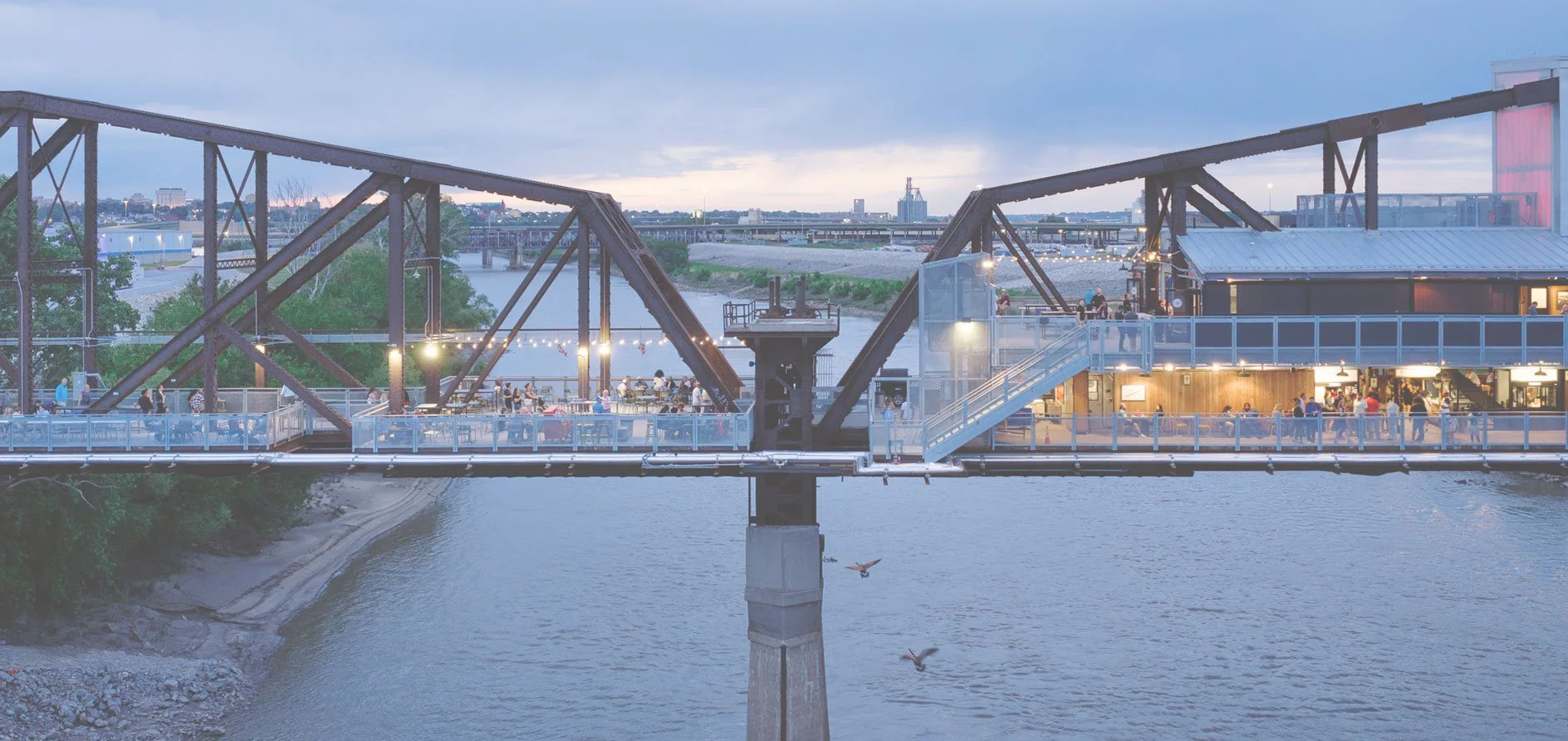
NARRATION: It seems to have paid off. Now the site is a two-story, 700-foot-long bridge that can hold 1,500 people at a time. It houses a restaurant, a bar, an event hall, 16 bathrooms, drinking fountains, a chess park, a bike trail, and an open deck with seating – all ADA accessible, all open to the public.
NARRATION: Michael and his team did make sure the bridge’s old bones were up to the task of holding a double-decker development on its back.
MICHAEL: The engineers who did the initial feasibility study, we had to find out if it was stout, and it turns out it is because it's a railroad bridge, so it's built, under heavy construction. And unlike car bridges, it was never salted in the wintertimes. So it's very robust. We had to replace a few beams here and there, but by and large, it was good to go to carry these loads that we have now.
NARRATION: Michael shows us around, as trains and planes go by in the background.
MICHAEL: This is the River House Restaurant. It's operated by food and beverage tenants who pay rent to Flying Truss, and then we pay rent to the city of KCK.
…It's a lot of steel and a lot of concrete, but we've got colorful chairs and tables that we brought in from Italy. The tenant did a wonderful job of hanging these really bushy ferns from the ceilings, and we've got these historical photographs on the walls everywhere.
NARRATION: The restaurant seats about 200 people for lunch and dinner. It’s still a beautiful October day when we visit, but colder weather is on its way.
MICHAEL: There's about 17 or 18 large ceiling gas heaters. And once it does cool off a little bit, we just push this button And all the screens go down to stop air movement. This is a indoor-outdoor space. It's not thermally insulated, but we're stopping air movement and warming that air.
NARRATION: The restaurant also doubles as a kind of museum.
MICHAEL: There's no place in our metro that really celebrates our railroads, our big rivers, and the bridges that cross them. There's no cultural institution, there's no bar, there's no restaurant. The Rock Island Bridge is that place. And lucky for us, we found a trove of imagery, of blueprints, photographs, sketches of our bridges and our rivers. We've been photographing them on drones and we also have been printing them out, and putting them on big metal boards with frames all across the bridge.
NARRATION: Michael’s company supervises everything and keeps the bridge clean and safe, and they also program it for public and private use.
MICHAEL: You can rent the top deck event space for a wedding or a corporate event. But most of the programming we have out here is just enlightened self-interest. …It’s open to the public. We got a wide array of things from primal scream therapy to live music to salsa dancing every week.
NARRATION: Everything here is branded as “on-a” out here.
MICHAEL: O-N-A. The chess tournament will be the first chess tournament on a bridge. We do yoga on a bridge. There's salsa dancing on a bridge. You gotta have some fun with it. You know, when you're on a 120-year-old railroad bridge over a river, you can't take things too seriously.
NARRATION: And it goes without saying that all of the activity out here “on-a” bridge - hovers over the Kansas river that flows along the border between Kansas and Missouri.
MICHAEL: At the base of the stairs, you're in Missouri. You come up, and you walk across the bridge, and you're all the way in Kansas for the full trip.
NARRATION: The Kansas City metropolitan area is a divided metro between the two states of Kansas and Missouri. And there’s a bit of historic rivalry between the two.
MICHAEL: What's fun about this project, it's one of those places that brings us together. Obviously, it's a bridge, which is symbolic of bringing things together, and it's right here at the border.
NARRATION: It connects two trail systems between the states. The bridge itself, though, is entirely in Kansas and owned by the Kansas City government.
MICHAEL: They needed it to link the trail tops that were emerging on both sides because Wyandotte County, where Kansas City, Kansas, is, has some of the lowest health outcomes in the state of Kansas, and that's a result of poverty and a lot of complex things, including a lack of places for families to go for free, to walk and ride their bikes and do things, and levee tops are a natural place to do that because you're up high and you're looking at a river. And they wanted to use this bridge as a vital link in that emerging levee top system.
NARRATION: It also makes good business sense to have amenities right in the path of a trail with access to two different states in a metro area of more than 2 million people. The restaurant, bar, and event space have already had their share of crowds, as the bridge opened just before the start of the 2026 World Cup.
MICHAEL: We did have some sensational watch party nights. Yeah. One night we had about 500 or 600 Mexico fans out on the bridge with their families and a band, and we set up a big TV array, and that was really a lot of fun.
NARRATION: But, it hasn’t been all fun and games getting this ambitious and expensive redevelopment project to the finish line.
MICHAEL: I was a guy who had never built anything, trying to build something that had never been built with no money,
NARRATION: Linking up with an experienced investor and developer early on gave Michael a boost. Enter David Brain.
DAVID: Hi, I'm David Brain. I'm a real estate investor, financier, and developer, and got involved with Mike Zeller on a crazy project to pursue changing a railroad bridge into an entertainment and restaurant venue.
NARRATION: David had already been financially involved with some large local retail ventures like a movie theater, an indoor golf entertainment complex, and a place called Chicken and Pickle – offering comfort food and… pickleball.
DAVID: Food and beverage usually pays the bills,... now, we didn't think about it was gonna cost as much as we did to build this out. But, it seemed like, given my experience with a lot of other destination properties, this could be a very attractive and very interesting place with a good patronage that would be able to financially support a decent project.
NARRATION: About that cost… the price tag to plan, market, design, build, and open the bridge, he estimates to be about $22 million. They also received significant in-kind contributions – including pro bono legal help from a local law firm. But they had formed an LLC and started selling equity. Here’s Michael again.
MICHAEL: We did a $500,000, friends and family round, which filled surprisingly quickly. A gentleman who read a story in the Kansas City Star phoned me up, and I met him at a local coffee shop, and he invested $100,000. … He fell in love with the project. You know, he wants to get his money back. So it's that twofer that I was talking about. It's civic capitalism. Our startup exists at the margins between private enterprise and public service. There's a void there, and we're getting more creative in the United States. We're putting tea shops in parks. We're using a parking lot for office parking by day and residential parking by night. Things don't have to be single purpose or single entity-driven.
NARRATION: That said, both the timeline and the budget for the project grew more than they had anticipated. Here’s David.
DAVID: This project did have a lot of slippage in terms of time, and it had slippage in terms of budget because all of a sudden we realized on the fly that, hey, the weather conditions are such that we're going to have to do something different than what was originally designed.
NARRATION: There were material and labor cost increases. There was a global pandemic…
DAVID: So the budget really expanded probably by 50%, to get to the final figures. … It was frustrating for investors, but I think the good news is there was a lot of love for the project and there was a great amount of indulgence and understanding that got us through it.
NARRATION: To their credit, they had gotten the unified government of Wyandotte County and Kansas City, Kansas on board. So rent for the bridge was heavily subsidized.
MICHAEL: They wanted us to go big because they wanted to use this former bridge as a catalyst to rebrand and transform the Kansas River, which has been overlooked for 125 years in Kansas City.
NARRATION: Even the governor of Kansas, Laura Kelly, gave her thumbs up on the project.
MICHAEL: She likes to refer to herself as the fun governor, and so she wanted to do more things in the state that were fun and created really, destination entertainment recreation.
NARRATION: Michael says this project turned into a real barn-raising for Kansas City.
MICHAEL: This project was a real barn raising for Kansas City. Infrastructure renewal projects, like the High Line famously in New York, can redefine whole quarters of cities, but they're a very heavy lift. Too heavy, often, for local government to do alone, or for philanthropy alone, so we ended up with a P6. Everybody's heard of public-private partnerships, … this is actually a P six. … Public, private, philanthropic, patient capital, pretty great Kansas City companies, partnership. It's a real kitchen sink approach to doing something that no one of those sectors or two could have pulled off alone.
NARRATION: Another boon for Rock Island Bridge was being invited to join the High Line Network.
MICHAEL: My partner, Michael Latin, and I attended a High Line conference in Miami about four years ago, and the focus there, of course, was the Underline, below a train track. And we met a lot of fellow travelers there, from these projects across North America, and it really gave us inspiration, and we made friends, and we shared notes and experiences. And we also talked to the leaders of the High Line, and at first, they couldn't quite get their head around the fact that we were this, LLC, but then they invited us to join because they think that there's great potential in this super collaborative approach that also brings private capital, private energy to public projects.
KIRA: Everybody's got their own, individual recipe for how they pull together all the funding..
NARRATION: This is Kira Strong again, with the High Line Network.
KIRA: ..because you really are pulling together so many different funding sources to lift these kinds of projects off the ground. And I think this is part of the support the network provides as well, you go through pushing this, boulder uphill and this race to get these projects built- And then you realize you have to actually fund and maintain and operate what you just built.
NARRATION: It can be frustrating and lonely work, Kira says.
KIRA: …And so that kind of commitment and tenacity to keep going, sometimes you need a little help, and it helps to be surrounded or be able to connect with others who are in your shoes or are a little beyond and can say, "Just, hang in there," and, "Have you thought about this?" Or, "Have you talked to so and so or maybe this funder?" Or, "Here's a sample agreement of what we did with our city, and maybe you take that to your city, because it's been done and tried and true and, also might save you dollars with legal fees, for example."
NARRATION: She longs for a day when there are dedicated federal funds for infrastructure re-use projects like these.
KIRA: And to really think about what that looks like if we were on a federal level to allocate funding specifically to rethink disused infrastructure and to create these kind of dynamic spaces.
NARRATION: What Kira and the High Line Network have done in the meantime is produce a training manual of sorts for new project teams navigating the process. It’s called the Community first toolkit.
KIRA: The Community First Toolkit is a resource that came out of network members, talking about as they're engaging residents and stakeholders in their communities, recognizing that They all had their own way of doing this, and some had done it before, some hadn't, and reaching out to each other and to us to say what's a framework for centering equity and residents in the middle of these conversations as we envision a public space, that may draw people beyond just this neighborhood?
…So that was the genesis of the idea, the beginning of creating an actual applied, "Well, how do I do this? If I'm new to community engagement and I have an idea, what do I do next?" And then testing those tools. And that turned into a publication,
NARRATION: The High Line Network offers this document as a free download on their website.
KIRA: And it walks you through step by step, here's how you start…You are going to … ideally acknowledge the history of where you're working. You're going to engage stakeholders. You're going to be very practical about setting expectations and you're going to build trust.
NARRATION: Kira says they’ve seen so much use of the toolkit in the last few years that they’re turning it into an in-person training for folks wanting to develop these kinds of infrastructure re-use projects. And they’re not doing all this just so a few renovation projects can succeed. They also know when these public/private hubs can thrive – the positive impacts tend to ripple out. Especially when equity is intentionally built into the process.
KIRA: 11th Street Bridge in Washington DC is known for having done a lot of … laying the groundwork for thinking about what does affordable housing look like? What do job opportunities on this multi-year construction site, they're just about to break ground, look like for neighborhood residents? And how do we create on-ramps for residents who currently live around these spaces to be engaged?…All of our network members are really thoughtful about that, Buffalo Bayou in Houston comes to mind, who, they themselves took on the building of affordable housing in proximity to their green space.
NARRATION: Some of the High Line Network developments also offer job training.
KIRA: They're really thinking about how do they bring neighborhood residents into the design or construction fields, or the horticulture fields and maintenance fields, because they've created an opportunity with the space that they've just built or are about to build.
They're thinking beyond just, "I'm building a beautiful green space." They're thinking about sustainability. They're thinking about climate impacts. They're thinking about education opportunities for youth in the neighborhood. So many of them have programs in these areas. It's really impressive.
NARRATION: Michael Zeller with Rock Island Bridge also sees his project as a catalyst for more economic growth near the Kansas river. There are already new apartments being built nearby.
MICHAEL: There's also some other entrepreneurs that are in the process of purchasing two double-decker faux riverboats to pin along the side of the river with steel pilings and rent kayaks, canoes, standup paddleboards off of one, and then later on, their goal is to have a coffee shop, bar, rental space on the river as well and light it up.
We think that's a great addition because more is more. The more you activate the river, uh, the more interesting it is for everybody, and this becomes more like an ecosystem rather than something standing alone.
NARRATION: Rock Island Bridge’s David Brain is already thinking about how their team might help replicate this kind of renovation elsewhere.
DAVID: There's certainly a number of mothballed bridges around the country, and there actually is motivation for their ownership, whether it's still the railroad or the city, to find somebody to take them on so that they don't have to stay in ownership and responsibility for them. … And since we've gone through the experience, I'll call it – the learning curve of development – it seems a shame to not utilize that again, to let it go to waste.
NARRATION: Michael echoes his partner here.
MICHAEL: Repurposing an unused bridge is not a new idea. But surprisingly, no one in the modern era has taken an unused steel bridge and treated it like land, brought all the utilities out, built buildings, did land-like things like have an event space and a restaurant with bars and public gathering spaces, concert venue. And we've done that first here in Kansas City, and we expect to see it elsewhere.
NARRATION: Not only have they done all this, they’ve even succeeded in getting chicken on the bridge! It's on the restaurant’s menu and..
MICHAEL: As a surprise celebration, some old friends of mine, one of the architects who helped me think this thing through, bought a taxidermy chicken that they had, shipped in from North Dakota and it's in a, glass box up there behind the bar, and we call it Little Mike.
NARRATION: So the next time you see an abandoned old bridge, highway overpass, railroad track, grain silo, industrial factory, or waterfront – give it another look, and try to imagine what it could be. With the support of the High Line Network, it might just become your neighborhood’s next best public space.
If you want to check out photos of the original High Line, the Rock Island Bridge, and other High Line Network sites, visit us at builtpodcast.com. Built is a co-production of Fidelity National Financial and PRX Productions. From FNF, our project is run by Annie Bardelas.
This episode was produced by Ali Budner and Sandra Lopez-Monsalve, with associate producer Gigi Polizzi. Sylvia Maria Gross was our location producer in Kansas City. Our editor is Genevieve Sponsler. Audio mastering by Rebecca Seidel. The Executive Producer of PRX Productions is Jocelyn Gonzales.
Special thanks to our guests, and to Janelle Grace and Frances Murray at the High Line Network.
I’m Brian Maughan. Thanks for listening to BUILT—where we explore forward-thinking developments in distinct markets, reshaping our BUILT world.